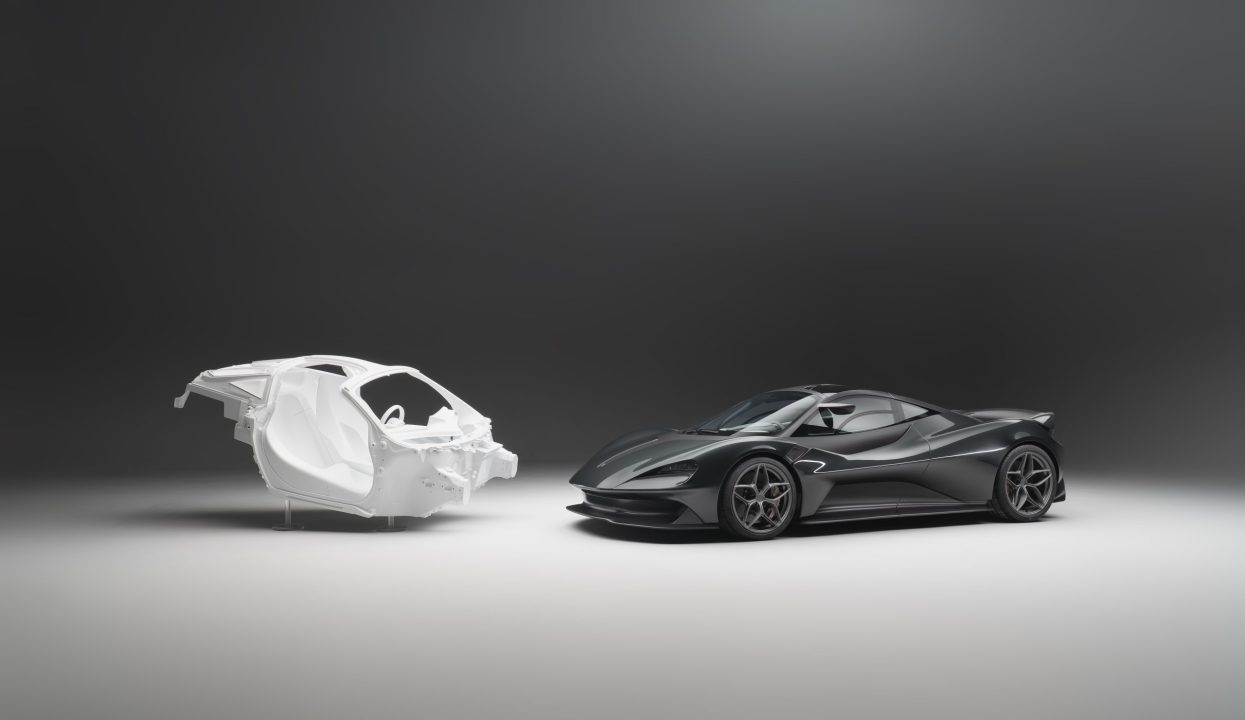
A particularly centric highlight at this year’s Goodwood Festival of Speed is Lanzante’s 95-59 supercar, marking 3 decades since the team clinched outright victory at 1995’s 24 Hours of Le Mans with McLaren F1 GTR #01R. Drawing on the company’s extensive supercar expertise & knowledge banked over the intervening 30 years, the bespoke new 3-seater will embody the very meaning of ‘driver focused’ with its central driving position pioneered by the F1 back in the early 90s.
Even the name 95-59 speaks of the iconic history behind Lanzante’s latest project: 95 represents the famous Le Mans victory’s year, while 59 was the winning McLaren’s race number. The car itself represents a step change in contemporary supercar design just as the F1 itself did, shifting focus back towards obsessively deep design thinking, engineering & technical innovations to result in an exciting yet highly usable driver focused car with proper cruising range and luggage capacity.
Dean Lanzante explained, “95-59 is the result of everything I personally and we, as a business, have learned and experienced over three decades since winning Le Mans.”

At its core, 95-59 is built around a current McLaren carbon fiber monocoque platform, meticulously re-engineered to accommodate the hallowed 3-seater layout with no compromise to its proven torsional strength & versatility. Debuting at Goodwood’s historic estate, the production-intent styling concept’s full carbon fiber body is finished in the exact same Ueno Grey shade as the 1995 Le Mans winning F1 GTR.
Bringing extensive design experience to the project, including the McLaren P1 & 720S, Chief Designer Paul Howse explained, “95-59 has a very natural balance to it. By its very design, with the driver as the focal point, it works as a piece of design, with symmetry and very natural forms. The design is a continuing development of my design theory, based on the efficiencies of organic shapes, and we have worked hard to deliver something that pushes the boundaries. Like the famous win 30 years ago, 95-59 is something that has not been seen or done before. However, working closely with Dean and the team at every stage, we have developed a design which stays true to the ethos of everything Lanzante has become known for over the past three decades.”
Powered by a revised 4 liter twin turbo V8 engine, 95-59’s outputs are targeted to exceed 850 bhp & 880 Nm of torque, while weighing no more than an expected 1,250 kg when equipped with the optional ‘LM30 Pack’. This package shaves another 20 kg of weight with super-lightweight forged aluminium wheels, titanium body mountings, Inconel exhaust headers, titanium exhaust secondaries & tailpipes, and gold-plated heat-shielding employed throughout the engine bay & exhaust surrounds for its superlative heat insulation. The resulting 700+ bhp / ton power-to-weight ratio elevates 95-59 into a highly esteemed supercar echelon, while a map of the Circuit de la Sarthe embossed into the driver seat’s headrest & scrutineer-style chassis plaque represent historical nods to the project’s storied roots.

Lanzante’s journey of delivering highly specialized road-going race car based projects began in 1997, with a McLaren F1 GTR’s adaptation for its owner’s road use. From that origin, Lanzante has crafted beautifully designed and specially bespoke automobiles for the world’s most discerning driving enthusiasts. Led by Dean Lanzante, the team has garnered an unbeatable reputation for the design and build of bespoke tailored commissions based on some of the world’s most iconic supercars; from track dedicated Paganis to Porsche 911 GT1s and the 930 TAG Turbo restomod project.
The aforementioned F1 GTR owner still calls the Lanzante crew family right until the present day, and has been integral to 95-59’s journey since its inception. This closely collaborative partnership involving feedback from both themself and an incredible client base, including owners of 3-seater models, has proven vital to the project’s evolution. Each of them shares in the obsessive vision for perfection that Lanzante has become renowned for, and 95-59 was conceived with them foremost in mind.
Indeed this is much more than ‘just an expensively rebodied 750S’ as some quarters would claim it to be; rather it has been intended to connect its drivers with a purity of driving possessed by no other road car. As Dean explains, “Crossing the finish line at Le Mans was actually the start of this journey to where Lanzante is now, and we are always looking to push boundaries and perceptions. Our projects regularly require us to answer the questions that others have either not wanted to ask, or have avoided, and I am proud to keep asking the questions to push what is possible.”

“The original brief of ‘Project 95-59’ was to create something accessible and usable, for drivers. Three seats, luggage space, enhanced range; something drivers could, and wanted, to use. We wanted to deliver the same enjoyment and passion of buying and owning a classic car but in a contemporary way. Full focus on what the driver needs and wants, with a blend of modern technologies but pared back to maintain driver focus.”
With 95-59’s design led by Paul Howse, its muscularly flowing lines embody a natural evolution from his previous designs. Dean Lanzante added, “Paul was the natural choice for leading the design of this project, and bringing our thoughts to life. The McLaren P1 changed the game in terms of design when it was first unveiled, and still looks modern and fresh today. We worked with him on the P1 Spider, and 95-59 takes his concepts and design language to the next level.”
Paul detailed, “95-59 is making a statement, on a number of different levels. It is the distillation of everything that Dean and the Lanzante team has learned and experienced since one of the greatest achievements a team can make in motorsport. With that as a starting point, it is a strong foundation. For me, personally, it is also the culmination of ideas and thoughts I have had throughout my design career, working across different projects.”

“Having taken a step away from car design in recent years, and now coming back to it with fresh eyes, 95-59 has given me a chance to re-evaluate and engage all the experience I have gathered, and approach things with a more mature and refined approach. With the forms and designs now able to be created through new technologies and the latest innovations, 95-59 is the ultimate expression of what I have always wanted to create.”
“The central driving position was a key part of the initial discussions for this project. We wanted something that looked organic, with an aggressive edge to it, but clean. In the same way fighter jets are designed with purpose and poise, without superfluous intricacies and design trends. The final design is beautifully balanced and cohesive from every angle, without being ‘on trend’ or following the current design rules. It is not so much as a nod to heritage, but because it is fundamentally correct – I like to think we have created something that is unlike anything else; building its own legacy.”
Each line, surface and angle of 95-59 was formed for a specific functional result, in close concert with the engineering team. Designed around the innate efficiency of organic shapes, it is defined by clear aerodynamic air paths that have always been characteristic of Paul’s designs. These aerodynamic paths are distinctly visible throughout its two-layered design, with the lower visual carbon fiber surfaces generating downforce and venting front wheel well pressure, while further aero optimized surfaces are wrapped tightly over its top.

Viewed from the front, the nose’s very low leading edge dominates things, with a ballistic aerodynamic form extending its line. The seamless, single-piece clamshell bonnet emphasizes the central seating position with a central ‘V’ form flowing into 95-59’s interior & steering binnacle. It has also been engineered with an integrated trailing edge duct that ejects front wheel arch air pressure, while maintaining a beautifully clean surface compared to more traditional louvres employed by other manufacturers. It then flows this air along the twin-layered, sculpted dihedral door flanks, with the resulting stream then split across the rear quarter panels and ducted into bespoke high efficiency radiators. These are especially designed for maximum cooling without compromising the 95-59’s exterior design language.


A bullet trajectory-like design highlights the side profile’s air-piercing aerodynamic efficiency. Originating from the nose’s low leading edge like a bullet’s tip, this is the point which all lines and surfaces expand from, resulting in a design with visual energy in every element. Flowing cleanly with intent from the 95-59’s nose to its tail, this central ‘bone line’ gives its overall stance a raked cohesion like a cheetah about to pounce.
Paul added, “With 95-59, we wanted to push the ‘bone line’ – or waistline – as low as possible. It is traditionally quite high on modern cars, but with a lot of work completed to lower the nose and rear packaging, we were able to keep this focal point much lower, thus lowering the visual mass of the overall package.”


A tightly sculpted rear end dramatically rounds things out with its athletically low deck, visually concentrated around the titanium central exhaust as its focal point. This was inspired by the fifth-generation F22 fighter jet’s brutalist-organic forms, with the floating active aero rear wing positioned above it. The wing itself is extendable into a more dominant aerodynamic position, increasing rear downforce during spirited driving. Paul recalls, “We came up with tens of different concepts for the rear of the car – with a link to the heritage of the project, but moving things on in our own way, so it stands on its own as a piece of cohesive design. Function has helped create the form, and through developing these efficiencies at the rear, and innovative packaging solutions under the bodywork to evacuate as much heat from the rear of the car, we have been able to refine the initial concepts. Combining this with the latest in lighting technology and pushing the trailing edge of the bodywork as low as possible, the rear of 95-59 makes a real statement.”


Overall cohesion was another vital factor in designing the 95-59, with its interior crucially following the same organic design philosophy as its exterior. Paul added, “It was critical to us that the design language of 95-59 flowed as seamlessly as possible between the exterior and interior. We worked hard to ensure there was cohesion around the full exterior, and the full interior for occupants, with the team working hand-in-glove across both aspects, in parallel. This has led to a symbiosis between the bodywork and the cabin, with design features, shapes and forms linking between the two, which is rare.”
The central bonnet’s graphic hints at the cabin’s central driven layout, while the front clamshell’s tips are echoed in the dashboard’s outer forms. Meanwhile, the dashboard’s bone line flows uninterrupted into the door cards, with the dihedral doors themselves enabling a more effortless entry & exit experience than most other mid-engined supercars.

Of course, the centrally mounted driver’s seat dominates the interior, while glass roof panels and upper roofline elements bathe the cabin with ample natural light, providing a refreshing sense of airiness & excellent outwards visibility. Further aiding outwards visual cognition, the external side mirrors are optimally positioned up on 95-59’s A-pillars, just as they were on both the concept & certain production examples of the McLaren F1. The central driving position’s benefits are already well-documented: as its driver, you are positioned exactly in the car’s center, with equally ideal sight lines on both sides along with a uniquely direct sense of how the car moves beneath you. It also gives a very real sensation of being in command of the machine, or of driving an F1 Grand Prix car if you will, and is a big reason why the iconic F1 remains so highly sought after.
Switch packs are functionally repositioned in line with the usefully clean design, further easing ingress & egress on both sides. The centrally mounted steering wheel instinctively integrates transmission control buttons, while ancillary controls are positioned ergonomically both in the roof pod and within easy reach on either side of the steering wheel.


Although the relocated steering column & pedal box are now fixed, the driver’s seat is mounted low on lightweight runners. As for the passenger seating, this has been formed right into the carbon fiber chassis itself, with integrated headrests & leg support. Outer edge supports for both the driver’s and passengers’ feet are also especially incorporated into both sides of the central driver zone built into the chassis floor. With the passengers’ seating thus lowered, the low rear deck scuttle provides clear visibility to the rear plus useful additional storage room.
On top of thrilling performance and a highly driver focused ethos, useability is another major factor in ensuring that 95-59 owners can fully enjoy their cars across various scenarios. Dean concluded, “Throughout this project, we have worked very closely with a small, select group of valued clients to understand exactly what will actually work, and how they would potentially use a car like this. They have been on the journey with us – some for many years – and they are a mine of information, especially those who know the merits and limitations of owning and using a central-seat car. It has been as important for us to create the ultimate product, that pushes what is possible and challenges people to understand the engineering behind it, but which also meets the needs of those people who will ultimately own and run it. It has been a really fantastic experience of learning, and listening, while also looking for new or innovative processes.”

Ensuring that the 95-59 can be fully enjoyed & experienced on the road or racetrack, there is space for multiple luggage bags beneath its front clamshell, while its 75 liter fuel tank provides usable cruising range. Even the ownership experience has been crafted to be cost-effective and effortless, with a focus on ease of use, maintenance and servicing.
This is so much more than just another fancy supercar for those with a million Pounds to spare in their bank accounts. It isn’t about the vivacious flamboyance of the Italians, nor the brutish straight line power of American performance machines or even the headline record chasing that so many newer supercar startups engage in. Rather, 95-59 is a car entirely focused on providing a more connected & nuanced kind of driving pleasure, through an obsessively deep approach to its design, engineering and weight optimization. It draws on over 30 years of race winning heritage and bringing life to some of the world’s most special cars, for perhaps the most consummate & relevant cadre of enthusiastic owner-drivers anywhere around the globe.
In a final gesture honoring F1 GTR #01R’s race winning number itself, only 59 cars will ever be produced. And during a time when the motoring realm is fixated on performance numbers and other, more overt shows of force that don’t necessarily translate into real-world driving pleasure, here comes a true breath of fresh air that should also perhaps be an impetus for us to re-consider the meaning of the word ‘supercar’ itself.